
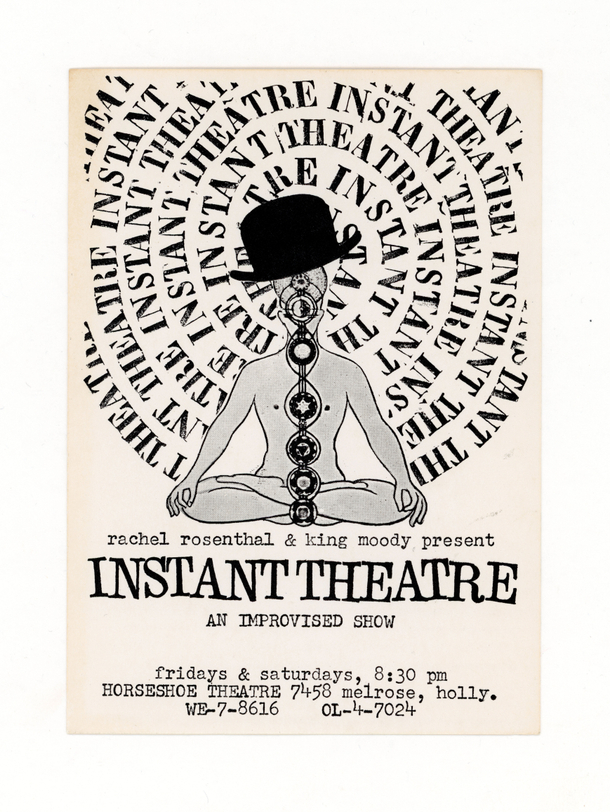
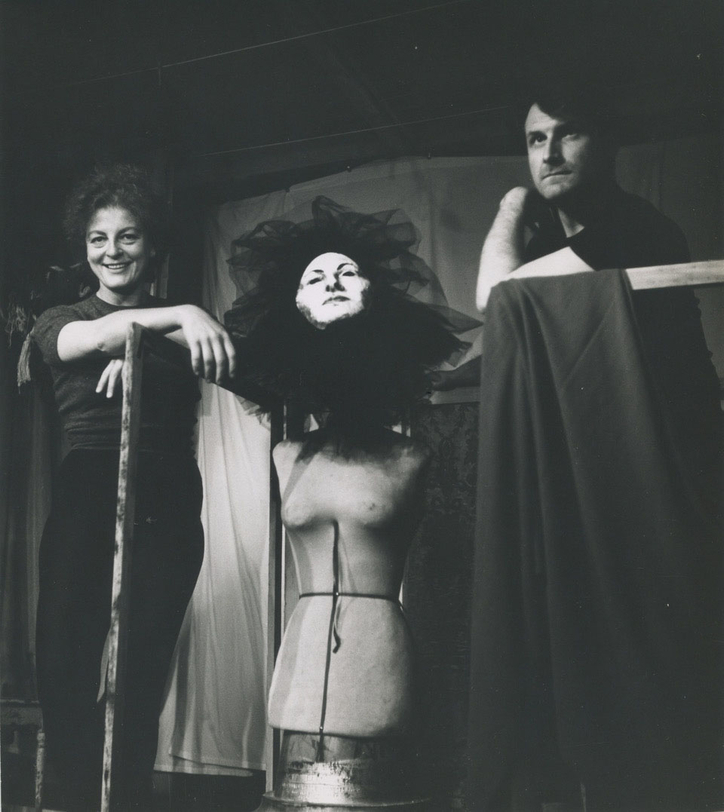
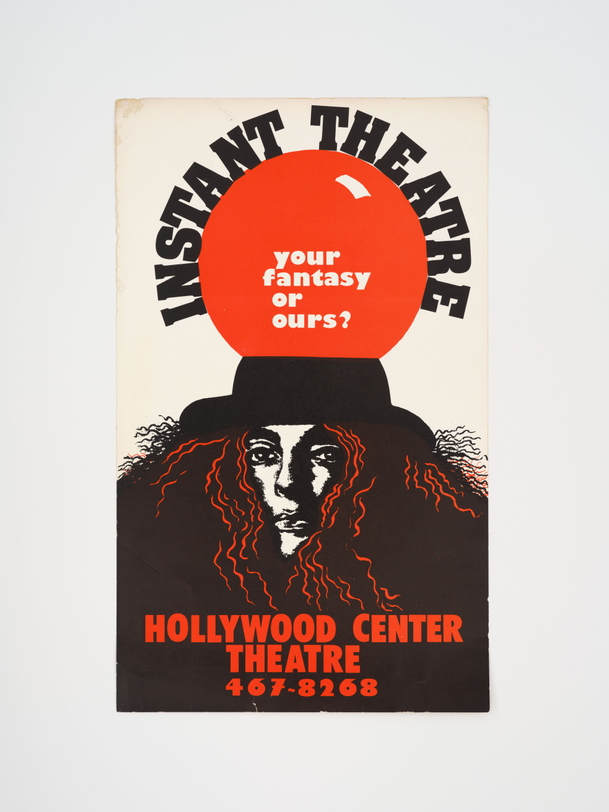
Roberts Projects is pleased to present Instant Theatre: Rachel Rosenthal and King Moody, an exhibition exploring the experimental theatre movement founded by Rachel Rosenthal in 1955 and continued with her husband, King Moody, from 1956–1966. Featuring archival material and design elements that invoke the setting and atmosphere of these ephemeral events, the exhibition reconstitutes Instant Theatre for the present while situating it historically as a precursor to the performance art of the 1960s and 1970s. While highlighting the importance of the movement itself, the exhibition also spotlights Rosenthal as a powerful artistic force in her own right—one whose influence and contributions continue to be felt today.
Instant Theatre was created from a combination of opportunity and accident. After settling in Los Angeles in 1955 after living in New York City and Paris, where she was part of an artistic community that included Robert Rauschenberg, Jasper Johns, Merce Cunningham and John Cage, Rosenthal began hosting workshops with studio and theatrical actors alike, asking them to bring prepared material that the group could experiment with and develop. Rosenthal had to pivot when actors arrived unprepared, providing her with the opportunity to use her own ideas and artistic sensibilities to create material and structure on the spot. She developed acting exercises influenced by Zen Buddhism just as much by the writings of Antonin Artaud and work of Jean-Louis Barrault, which stressed improvisation through a heightened attention to the present—to living in and reacting to what is happening now. This original group, which included painter Lee Mullican, worked together for nearly a year before disbanding.
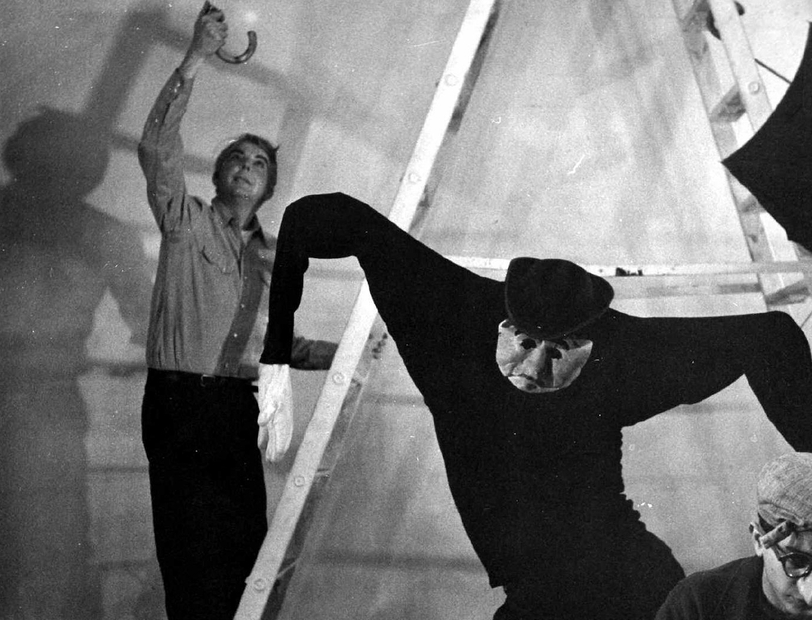
A year later, in 1956, Instant Theatre reformed through a collaboration between Rosenthal and her husband, King Moody. Now stationed at the Horseshoe Theatre in Hollywood, the group formalized its approach to instantaneous theatre with Rosenthal at the helm. Performances typically lasted between 45 and 60 minutes and were completely free in form and direction, with the mood and tone of the set design often serving as the initial point of departure from which actors developed a performance in real time. The set design and production regularly featured lighting created with handheld gels of different colors that suggested movement, while the music—originally recorded—was later created onstage with instruments. Another key element of the performances was their embrace of absurdism, expressed through the use of everyday objects in ways that were antithetical to their original purpose, a strategy that dislodged the audience from their habitual connection to the world as it was. Renowned for their immersive and transfixing nature, these performances were seldom documented—an act that ran contrary to the ethos of the movement.
Inspired by the spirit of the original performances, Instant Theatre will reimagine one of the gallery spaces as a theatre set. An assortment of original and inspired props—from fans and ladders to costumes and mannequins—will be arranged to suggest the presence of performers, while lighting will create shadows and dimension. In the adjacent gallery, the exhibition will bring together a wealth of archival materials, including photographs, paintings, postcards, invitations, and posters, alongside ephemera from Rosenthal's studio that likely served as props during performances, such as an old mattress spring, hockey pads, gas masks, and headdresses. More than a dozen prop masks will be affixed to the gallery walls and given painted bodies below them, suggesting the presence of an audience that can commune with contemporary viewers as they discover and connect with a groundbreaking artistic movement.
About the Artist
Rachel Rosenthal (1926–2015) was a pioneering performance artist, writer, educator and visual artist whose work profoundly shaped contemporary performance and feminist art in the United States and internationally.
Born in Paris to Russian parents, Rosenthal fled Europe during World War II and settled in New York, where she graduated from the High School of Music and Art and later became a U.S. citizen. After the war, she studied art, theatre and dance in Paris and New York with influential figures including Hans Hofmann, Merce Cunningham, Erwin Piscator and Jean-Louis Barrault. In 1955, Rosenthal moved to California and founded the experimental Instant Theatre. A key figure in the Los Angeles Women’s Art Movement of the 1970s, she co-founded WomanSpace and helped redefine interdisciplinary and feminist artistic practice. While continuing to perform, she also produced and exhibited visual art, including ceramic sculpture.
From the mid-1970s forward, Rosenthal focused primarily on creating original works for the stage, writing, performing and teaching. Her performances were presented at more than 100 venues worldwide, including Documenta in Kassel, the Festival de Théâtre des Amériques in Montreal, Kaaitheater in Brussels, ICA London, Performance Space Sydney, the Whitney Museum, Lincoln Center, and major festivals and museums throughout the U.S., Europe, Canada, and Australia. Major works include Pangaean Dreams (1990), FUTURFAX (1992), and Zone (1994). An influential educator, Rosenthal taught and lectured internationally at institutions such as Carnegie Mellon University, the Art Institute of Chicago, New York University, UCLA, CalArts, and the Naropa, Esalen, and Omega Institutes. Her numerous honors include an OBIE Award, an Honorary Doctorate from the School of the Art Institute of Chicago, the LA Weekly Theater Career Achievement Award and recognition as a Living Cultural Treasure of Los Angeles.