
Betye Saar

By Lilia Rocio Taboada
The story of Peter Pan and his shadow is well known by many. Peter’s silhouette is attached to his feet, but breaks free and runs away. The shadow represents elements of growing up that Peter seeks to reject—adulthood and the day-to-day responsibilities that emerge with age—by residing in what novelist and playwright James Matthew Barrie deemed Neverland. Peter’s shadow, however, is undeniably, his own. Even sprinting away, there is never any question it’s his silhouette. His shadow is his likeness, his past, present, and future all wrapped up into a figurative drawing rendered through light and darkness.
As a type of visual, Peter’s shadow evades the haziness of silhouettes. Most beg the question, how much is necessary to recognize a likeness at any age, state of life, or state of mind? Would you recognize the silhouette of your mother? Your father? A lover? Would you need the flick of hair or the curve of a nose as part of the portrait? Or, is what matters most the context surrounding the individual’s outline? Peter, with his forever youthful silhouette, recognized his shadow regardless of day, time, or place. One might imagine, then, that the outline was his constant companion on the never-ending days. Regardless of growing up, a type of self-recognition still occurred, with each line of his leg or arm etched into memory even within a place that exists beyond measure.
Skowhegan, in many ways, has a sprinkling of the placelessness and timelessness of Neverland. Participants enter a space for creative work without the self-consciousness and daily responsibilities that adulthood thrusts upon us. At Art School Road, as artist William King once remarked, “…that’s where they make the eternal, decide the eternal question, which is very simple: wake up in the morning, are you going to go to the studio and make art, or are you not? Two alternatives.”(1) That decision produces a different type of Never. Never commuting. Never life admin. Never cooking. Only art, people, and place. In Skowhegan’s Neverland, more time and space for making allows different shadow-self recognitions to ensue.
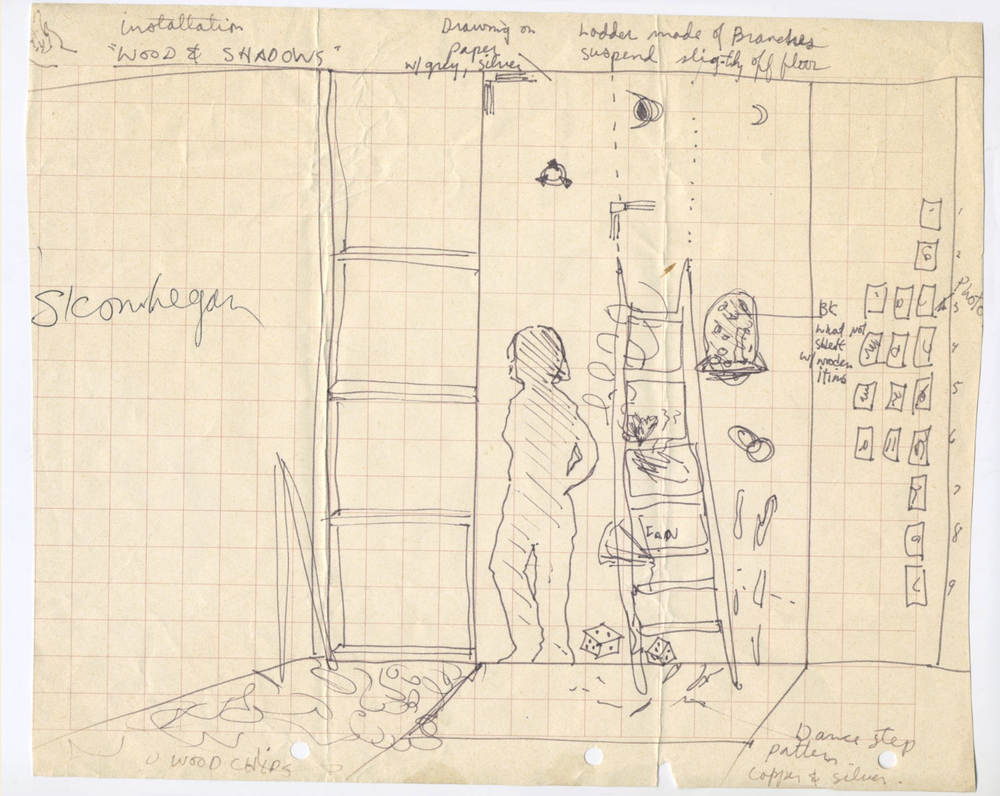
One recognition is the understanding of one’s practice and the personal capacity to learn and shift. Wood + Shadows by Betye Saar carefully delineates this light-made line between interior and exterior worlds. Saar, resident faculty during 1985, worked in assemblage since the early 1960s, often combining found images and materials referencing otherworldly entities and personal history into frames. These frames were shaped in some instances as windows, signaling perspective from one space into another. Other framing devices by Saar hold depth in the form of a shadowbox, a Victorian-era method of display for memories or mementos. With more depth, she creates assemblages reminiscent of altars found across time and place, like the Ghent Masterpiece or anonymous Los Angeles botanica windows. Saar transferred this combinatory style also into printmaking, utilizing the frame of the lithography plate to render the image of feathers, photographs, or other found objects from personal history and travels.(2) At Skowhegan, Saar experimented with framing at a human scale, transforming her studio into the shadowbox itself with her likeness at the heart of the Wood + Shadows composition.
Moving around the installation, her sketches and photo documentation tell which treasures she kept close to her likeness as memoirs or visions for her Shadow. On the left wall, small hatchets alternate with circles up to a wooden shelf alongside a time turner, found metal tools or hinges, and abstracted miniature wooden ladders. The bands and planks of the wooden studio walls create other small vignettes: a canoe beneath a silver hand print on bark paper; two miniature paintings framed within a found wooden frame; a gridded spool shelf underneath a small drawing of a bird; a framed wooden cowboy figure. Wood chips fill the floor, surrounding copper and silver footprints that meander as though dancing. White birch branches—native to Maine and common in other northern North American lake regions—frame a decorated piece of wood within the installation, and mark the edges of the floor composition. Sitting prominently within the chips are select other visuals including a small antique wooden rattle atop a makeshift bed, close to where Saar’s footprints step towards her shadow. The central wall made of paper forms its own vignette with her silhouette cradled by drawings of dice, time turners on a shelf, a fan, a fish, beads, and the moon above a birch branch ladder leading into the “sky.” Small photographs form a final edge of the work, difficult to discern from afar, but placed in a vertical line to mark a different temporality to what the shadow looks towards, and create a physical edge of the installation.
Saar’s outline looks towards the series of vignettes, recognizing various paths available in her personalized choreography through life. The dice and time-turners that surround her symbolize what might be on the horizon, following her time at Skowhegan and as she moves through this moment in her practice. Saar’s shadow first appeared in a 1983 installation titled In My Solitude, shown in “Visions: Margit Omar and Betye Saar,” at Art Gallery, Mt. St. Mary’s College, Los Angeles. The shadow as a form then held a central place as part of installations throughout 1984-86.(3) Saar depicted her shadow-self reading opposite an empty chair then lighting a candle in 1984—intimate acts of solitude—and by 1985 her shadow moved to the ladder with footsteps marking a shift from the intimate to the external, from existence in the past to looking to the future, as seen at Skowhegan. In the same way the shadow-self changed positions, the chair would eventually transform into a structure for altars as a symbol of ritual and religiosity.(4) Likewise, the ladder would appear and reappear in her work, understood as a reference to the narrative of Jacob’s ladder and ascension to Heaven in the Bible. A composite of these various symbols and forms in Saar’s practice, in Wood + Shadows, she shows us self-recognition of a period of change.
Transformation is difficult to convey, and yet in these images and context we see movement achieved within the static installation. During her lecture that summer, she describes this intention of change within her work as a newfound focus to “diffuse specific personal meaning.”(5) She also describes her travel to Mexico earlier that year, documented in her “Oaxaca” sketchbook, tracking her travels from Mexico, to Maine, then Hawaii in 1985 and how she, “…noticed the development of altars all over, to the point of interest in the idea of a ‘personal altar’.”(6) This idea of a personal altar is visible in Wood + Shadows, and offers depth into how she then went on to build installations throughout her career, effectively diffusing specific personal meaning while grounded in her specific personhood. Stephanie Williams, in “Orienting Acts: Toward Beauty & Mystery“, describes Saar’s journals as “mobile archives,” containers for drawing and observing, that were then released into large scale installation.(7) Saar’s oscillation from shadowbox to shadow studio presents a parallel example of how her work fits into “ever expansive discourses of orientation and translation,” moving inwards to move outward.
Little did Saar or her shadow know what would follow, but it’s clear both know how to explore the registers of meaning crisscrossing between personhood, religion, and culture that mingle in Wood + Shadows. The ladder, stated as a Biblical reference and also as a symbol of “raising consciousness to a higher level…stepping upward to a friendly star” would continue her expansive practice moving between two-dimensional work and installation.(8) While Skowhegan’s Neverland played a part in its gift of atypical structures of time and place, more central to the work is Saar’s combinatory, cross-temporal eye and her use of her shadow as a visual with the most personal meaning. Wood + Shadows is her intimate gift that allows us to witness transition—a constant period of life. And remember, Saar’ shadow is not Peter’s. She is growing, moving, and adapting, much in the same way a viewer can too whether they find themselves in the woods of Maine, or in the Neverland they seek elsewhere.